
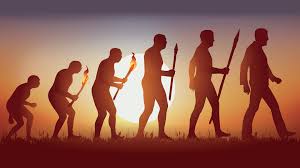
What if everything you believe about human origins… is incomplete?
For centuries, humans have asked one of the most powerful questions in existence:
👉 Where did we come from?
The answer isn’t simple. It’s a story that spans millions of years, filled with survival, extinction, adaptation—and a series of events that almost didn’t lead to us.
And the most surprising part?
👉 We are not the “final version” of humanity.
Let’s break down the real story of human evolution—step by step.
🧬 What Is Human Evolution?
Human evolution is the long process through which modern humans (Homo sapiens) developed from earlier species over millions of years.
But here’s something most people misunderstand:
👉 Evolution is NOT a straight line.
It’s more like a branching tree, with multiple human species existing at the same time. Some survived for a while… and then disappeared.
Humans didn’t evolve “from monkeys.”
Instead, we share a common ancestor with other primates that lived millions of years ago.
Over time, small genetic changes—driven by natural selection—favored traits that improved survival. These changes accumulated slowly, eventually leading to entirely new species.
But this raises a deeper question…
👉 Why did evolution go in this direction?
🧍 The Timeline of Human Evolution (Step by Step)
To understand how humans evolved, we need to look at the key stages that shaped our species.
🔹 1. The First Human Ancestors (7–4 million years ago)
Some of the earliest known ancestors of humans began to show one critical trait:
👉 Walking on two legs (bipedalism)
Species like Sahelanthropus and Ardipithecus lived in Africa and combined ape-like features with early human traits.
Why walking?
- Better view of surroundings
- Energy efficiency
- Free hands for carrying and using objects
This simple change would transform everything.
🔹 2. Australopithecus (4–2 million years ago)
These early hominins were small, but fully capable of walking upright.
One of the most famous fossils is “Lucy,” from Australopithecus afarensis.
They still had:
- Small brains
- Long arms
- Ape-like faces
But they had taken a major step toward becoming human.
👉 They were no longer just animals in trees—they were adapting to life on the ground.
🔹 3. Homo habilis (2.4–1.4 million years ago)
Now things start to change more dramatically.
Homo habilis is often called the “handy man” because of its use of stone tools.
This was a major evolutionary leap.
Tools meant:
- Better hunting
- Food preparation
- Problem-solving
👉 This marks the beginning of human intelligence as we know it.
🔹 4. Homo erectus (1.9 million–110,000 years ago)
This species represents a huge turning point in human evolution.
Homo erectus had:
- Larger brains
- Stronger bodies
- More advanced tools
But most importantly:
👉 They controlled fire.
Fire allowed:
- Cooking food (more energy for the brain)
- Protection
- Survival in colder climates
They were also the first humans to leave Africa, spreading into Asia and Europe.
This expansion changed the course of evolution forever.
🔹 5. Multiple Human Species (700,000–40,000 years ago)
At one point, Earth was home to several human species at the same time:
- Neanderthals
- Denisovans
- Early Homo sapiens
These groups interacted, competed, and even interbred.
👉 Yes—modern humans still carry Neanderthal DNA.
But eventually…
👉 All other human species disappeared.
Which leads to the biggest mystery of all.
🔹 6. Homo sapiens (300,000 years ago–today)
Modern humans emerged in Africa around 300,000 years ago.
What made us different?
- Complex language
- Abstract thinking
- Art and culture
- Advanced cooperation
We didn’t just survive environments…
👉 We started shaping them.
Around 60,000–70,000 years ago, humans began migrating out of Africa, spreading across the entire planet.
And from that point on…
There was no turning back.
🔥 Why Did Humans Survive (and Others Didn’t)?
This is one of the most fascinating questions in evolution.
Why us?
Scientists believe several key factors gave Homo sapiens an advantage:
🧠 1. Intelligence
Larger brains allowed better decision-making and planning.
🗣️ 2. Language
Communication enabled cooperation at a level no other species achieved.
🤝 3. Social Structures
Humans formed strong groups, increasing survival chances.
🔄 4. Adaptability
We could survive in forests, deserts, cold regions—almost anywhere.
💡 5. Innovation
Tools, fire, and later technology gave us an edge.
👉 In short: humans didn’t just adapt…
We adapted faster and better.
🌍 Where Did Humans Come From?
All modern humans trace their origins back to Africa.
This is known as the Out of Africa theory.
As humans migrated:
- They adapted to different climates
- Developed different physical traits
- Spread across every continent
Despite these differences:
👉 Humans are genetically extremely similar.
We are, essentially, one global family.
⚠️ Common Myths About Evolution
Let’s clear up the biggest misunderstandings:
❌ “Humans came from monkeys”
✔️ False → We share a common ancestor
❌ “Evolution is random”
✔️ Not exactly → Natural selection shapes outcomes
❌ “Evolution stopped”
✔️ Completely false → It’s still happening
🧠 Are Humans Still Evolving?
Yes—and this is where things get even more interesting.
Evolution hasn’t stopped—it has just changed pace and direction.
Today, humans evolve through:
- Genetic mutations
- Environmental changes
- Culture and technology
But now, something new is happening…
👉 Humans are starting to influence their own evolution.
With:
- Medicine
- Genetic engineering
- Artificial intelligence
We may be entering a completely new phase of evolution.
🔮 What Comes Next?
So here’s the real question:
👉 If evolution created us… what will we become?
Will we:
- Continue evolving naturally?
- Modify ourselves through science?
- Or become something entirely different?
The truth is…
👉 We don’t know.
And that uncertainty is what makes evolution not just a story of the past—
…but a question about the future.
📘 Final Thought
Human evolution is not just about fossils and ancient history.
It’s about understanding:
- who we are
- how we got here
- and where we might be going
And once you truly understand how unlikely—and incredible—our existence is…
👉 You start seeing humanity in a completely different way.
Not as the end of evolution…
…but as just another step in an ongoing process.