
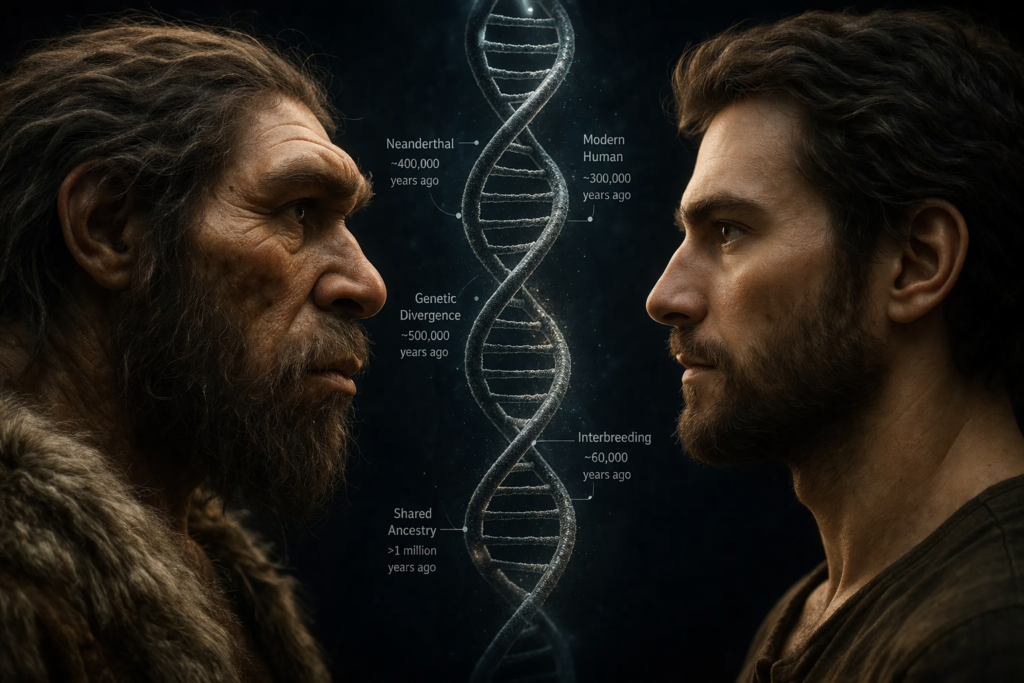
What if part of you… isn’t entirely human?
It sounds strange—but modern science has revealed something incredible:
👉 Humans and Neanderthals didn’t just coexist.
👉 They interbred.
And the proof of that is still inside your DNA.
🧬 Did Humans Really Mate With Neanderthals?
Yes—and this is no longer speculation.
Genetic research, widely published in journals like Nature, confirms that:
👉 Early Homo sapiens and Neanderthals had children together.
This happened around 50,000–60,000 years ago, when humans migrated out of Africa and encountered Neanderthals in Europe and Asia.
🧠 How Do We Know This?
Scientists discovered this through DNA analysis.
When researchers sequenced the Neanderthal genome and compared it to modern humans, they found something shocking:
👉 Non-African humans share about 1–2% of their DNA with Neanderthals.
This discovery was supported by studies from institutions like the Smithsonian Institution.
👉 That means interbreeding didn’t just happen—it happened enough to leave a lasting genetic mark.
🌍 Who Has Neanderthal DNA Today?
Not everyone has it equally.
- People of European and Asian descent → higher percentage
- People of African descent → very little or none
Why?
Because the mixing happened after humans left Africa.
⚙️ What Did We Inherit From Neanderthals?
This is where things get even more fascinating.
Neanderthal DNA isn’t just a random leftover—it actually affects us today.
Some inherited traits include:
- 🧬 Stronger immune responses
- ❄️ Adaptation to cold climates
- 🧠 Possible influence on brain and behavior
But there’s also a downside…
⚠️ The Hidden Effects of Neanderthal DNA
Some studies suggest Neanderthal genes may also be linked to:
- Higher risk of certain diseases
- Immune system overreactions
- Sensitivity to environmental factors
👉 In other words: evolution is not perfect—it’s a trade-off.
🤯 Why Did Interbreeding Happen?
This is still debated, but scientists suggest:
- Humans and Neanderthals were biologically compatible
- They lived in overlapping regions
- Small populations increased the chance of interaction
👉 It wasn’t unusual—it was part of survival and adaptation.
🔥 The Bigger Picture
This discovery completely changed how we understand evolution.
Instead of separate, isolated species…
👉 Human evolution was messy, complex, and interconnected.
Different human species:
- met
- interacted
- and even merged
🔮 A Question That Changes Everything
So here’s something to think about:
👉 If we are part Neanderthal… what does it really mean to be human?
Because the line between species may not be as clear as we once believed.
📘 Final Thought
The idea that humans are a “pure” species is no longer accurate.
We are the result of:
- evolution
- adaptation
- and even interaction with other human species
And when you realize that part of your DNA comes from a different kind of human…
👉 You start to see evolution not as a straight path…
…but as a complex web of connections.